That beautiful luxury vinyl plank you carefully selected could be failing from beneath. While you focused on color and texture, the invisible layer beneath determines whether your investment lasts for decades or fails within months.
We witnessed this harsh reality with Michael T’s Vancouver renovation. Despite using premium cork underlayment, his $12,000 luxury vinyl plank installation warped and lifted within 18 months. The culprit? Vancouver’s coastal humidity and concrete moisture vapor destroyed the flooring from below.
His flooring choice was perfect. His underlayment decision cost him thousands.
The truth is this: even the finest luxury vinyl plank will fail if installed over inadequate underlayment. Your flooring is only as good as what lies beneath it.
What Floor Underlayment Actually Does
Beneath every successful luxury vinyl plank installation lies an unspoken hero – the underlayment. This critical layer does far more than just cushion your steps; it’s the performance engine that determines whether your flooring investment pays off for decades or fails prematurely.
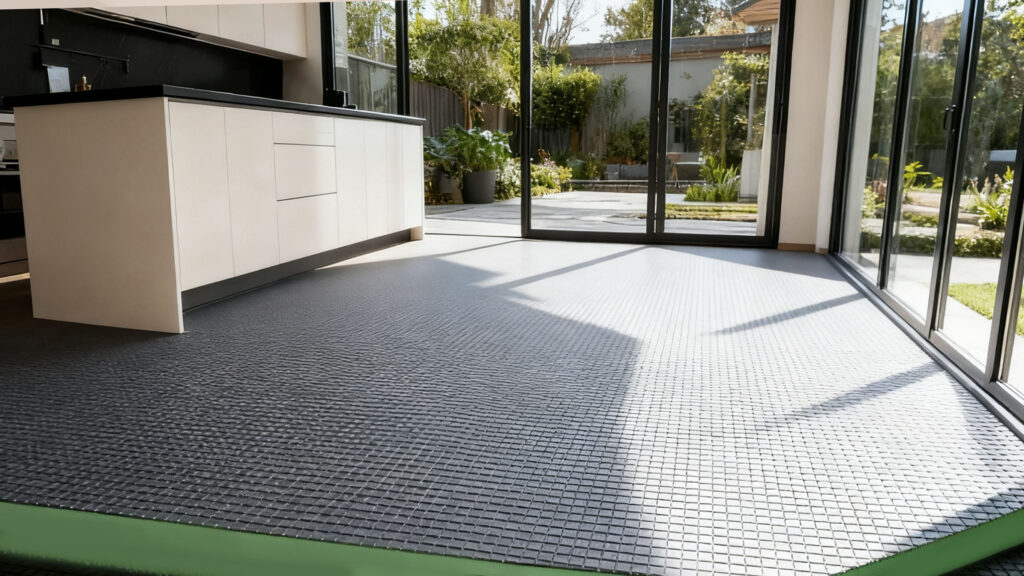
Three Core Functions That Make or Break Your Floor
- Moisture Defense System Concrete subfloors continuously emit moisture vapor – even when they appear dry. ASTM E96 testing shows a typical concrete slab releases 3-5 pounds of moisture per 1,000 square feet daily. Without proper protection, this moisture becomes trapped beneath your luxury vinyl planks, leading to adhesive failure, mold growth, and eventual warping.
- Thermal Break Technology In cold climates, uninsulated floors account for up to 20% of heat loss according to Department of Energy studies. Quality underlayment creates an essential thermal break that keeps rooms warmer and reduces energy costs – particularly crucial over concrete slabs and in basement installations.
- Surface Perfecting Layer No subfloor is perfectly level. ASTM E1155 standards permit up to 1/4-inch deviation over 10 feet, but luxury vinyl plank requires near-perfect flatness to prevent joint stress and eventual failure. The right underlayment bridges minor imperfections while providing essential cushioning that protects both the flooring and the subfloor.
Where Underlayment Performance Matters Most
| Application Scenario | Critical Need | Consequences of Poor Selection |
| Below-Grade Installations | Maximum moisture protection | Mold growth, adhesive failure, warping |
| Concrete Slab Foundations | Vapor barrier + thermal insulation | Cold floors, energy loss, moisture damage |
| Coastal & High-Humidity Regions | 100% moisture resistance | Expansion, buckling, microbial growth |
| Multi-Family & Commercial Spaces | Superior sound reduction | Tenant complaints, noise transmission |
| Northern Climate Zones | High R-value insulation | Heat loss, cold floors, increased energy costs |
The Reality Most Contractors Won’t Tell You
Many installers treat underlayment as an afterthought, but the truth is this: your luxury vinyl plank warranty often becomes void if installed over inadequate or incompatible underlayment. Manufacturers explicitly require specific performance characteristics – particularly regarding moisture protection and compression resistance.
The right underlayment choice isn’t just about comfort; it’s about protecting your investment against the hidden threats that destroy floors from beneath the surface. At Duolong, we’ve documented countless cases where proper underlayment selection prevented costly callbacks and ensured decades of trouble-free performance.
XPS Board Technical Advantages and Global Applications
Extruded Polystyrene XPS represents the engineering standard for demanding global flooring applications. Its homogeneous closed-cell structure, manufactured through continuous extrusion, ensures consistent performance across diverse climate conditions.
Thermal Resistance R value 5 per inch
Contrasting with cork’s R value of approximately 3 per inch, XPS delivers 40% greater thermal efficiency according to ASTM C518 testing. This translates directly to measurable energy conservation, particularly relevant across Scandinavia, Canada, and northern US states where ground temperatures remain cold through extended seasons.
Moisture Protection Near zero water absorption
ASTM C272 verification shows water absorption rates under 0.3% by volume – 10-15 times lower than cork underlayment. This scientific measurement confirms XPS won’t transport moisture from concrete slabs, safeguarding luxury vinyl planks from subsurface damage. In humidity-prone regions like Southeast Asia or coastal communities, this characteristic prevents microbial growth and flooring failure.
Load Capacity 50-100 psi compressive strength
This engineering specification from ASTM D1621 testing correlates to real-world performance. At 50 psi, XPS sustains residential applications effortlessly. At 80-100 psi, it supports commercial environments where concentrated loads and continuous traffic demand exceptional resistance to compression.
Service Life 20+ year performance maintenance
Independent laboratory aging tests verify that XPS preserves essential properties through decades of service. Unlike organic materials that deteriorate progressively, XPS provides permanent protection matching or surpassing luxury vinyl flooring lifespan.
Duolong XPS manufacturing incorporates rigorous quality verification, with third-party testing confirming consistent performance across production batches. This manufacturing discipline ensures architects and contractors can specify our materials with absolute confidence.
Traditional Cork Underlayment Applications and Limitations
Cork has served as a reliable underlayment material for generations, offering particular benefits in specific applications while demonstrating measurable constraints in challenging environments.
Advantages
Sound reduction represents cork’s standout characteristic, with IIC Impact Insulation Class improvements of 15-20 points in standardized testing. The natural cellular composition provides superior underfoot comfort, creating subtle cushioning. As a renewable material harvested from cork oak bark, it appeals to environmentally conscious specifiers seeking natural solutions.
Limitations
Moisture absorption presents the most significant concern. ASTM testing indicates moisture absorption rates of 3-5% under high humidity conditions – dramatically higher than XPS. This property renders cork inappropriate for below-grade installations or regions with elevated groundwater tables.
Compressive strength typically ranges 25-40 psi, adequate for residential use but potentially problematic beneath heavy furnishings or in commercial settings. Long-term compression set can reach 10-15% under sustained loading, potentially undermining flooring support over time.
Professional Selection Guide for Global Climate Zones
Matching underlayment performance to environmental conditions represents the decisive factor in ensuring long-term flooring success across different geographies.
Cold Climate Regions Canada Northern Europe Northern Asia
Priority Thermal insulation and freeze-thaw stability
Recommendation XPS with its superior R-value provides enhanced energy efficiency. The closed-cell structure remains intact through repeated freeze-thaw cycles, unlike materials that degrade under these conditions.
High Humidity Coastal Areas Southeast Asia Florida Caribbean
Priority Moisture resistance and mold prevention
Recommendation XPS establishes an impermeable barrier against ground-sourced moisture and humid air. The inorganic composition eliminates nutrition for mold and mildew.
Seismically Active Regions California Japan New Zealand
Priority Dimensional stability and compression resistance
Recommendation XPS maintains consistent thickness and performance characteristics despite ground movement or structural settling. The high compressive strength prevents deformation under dynamic loads.
Commercial Applications Retail Office Institutional
Priority Load distribution and long-term performance
Recommendation XPS at 80-100 psi compressive strength manages rolling loads and concentrated traffic without compromising support or creating uneven surfaces over time.
Eight Dimension Professional Comparison
Comprehensive evaluation across all performance criteria reveals application-specific advantages for each material, with XPS demonstrating superior performance in most categories relevant to luxury vinyl plank flooring.
Performance Comparison Table
| Performance Category | XPS Board | Cork Underlayment |
| Thermal Insulation | Excellent R5 per inch | Good R3 per inch |
| Moisture Resistance | Excellent 0.3% absorption ASTM C272 | Fair 3-5% absorption |
| Compressive Strength | Excellent 50-100 psi | Moderate 25-40 psi |
| Acoustic Performance | Good IIC improvement 10-15 | Excellent IIC improvement 15-20 |
| Installation Ease | Excellent lightweight scores easily | Good requires careful handling |
| Lifecycle Cost | Excellent 20+ year service life | Good 10-15 year service life |
| Environmental Profile | Good high recycled content long life | Excellent rapidly renewable biodegradable |
| Global Applications | Excellent all climate zones | Moderate dry stable environments |
When to Choose XPS Board When to Consider Cork
Choose XPS Board when
- Installing in basements over concrete slabs or coastal properties
- Addressing cold floors or optimizing energy efficiency
- Requiring commercial-grade durability
- Prioritizing long-term performance certainty
- Operating in humidity-prone environments
Consider Cork Underlayment when
- Sound reduction represents the absolute priority
- Working exclusively above grade in climate-controlled settings
- Managing budget constraints in dry applications
- Seeking natural materials for environmental certifications
Making an Informed Choice for Your Investment
Scientific evidence and global field experience consistently demonstrate that for most climate conditions and performance requirements, XPS board provides more comprehensive and lasting protection for luxury vinyl plank flooring investments.
While cork serves specific acoustic needs in controlled environments, XPS delivers proven performance across challenging conditions that compromise lesser materials. From Toronto winters to Singapore humidity, from residential renovations to commercial installations, the closed-cell security of XPS ensures your flooring investment remains protected for decades.
Duolong has supplied XPS solutions for architectural projects across twelve countries, with independent laboratory testing confirming our materials meet or exceed published specifications. Contact our technical team with your project parameters for specific performance data and sample materials.
Remember that your flooring installation’s success fundamentally depends on what lies beneath the surface. Choose foundation materials with the same discernment you apply to selecting finished floors.
Frequently Asked Questions
Q: What’s the biggest mistake people make when choosing an underlayment for LVP?
A: Hands down, it’s underestimating moisture. Especially over a concrete subfloor, which always emits moisture vapor. Skipping a true vapor barrier like XPS is asking for trouble—you risk warping, mold, and voiding your flooring warranty down the line.
Q: Is cork or XPS better for sound reduction?
A: Cork has a slight edge in lab tests for sound dampening. But here’s the real-world take: XPS provides excellent sound insulation that’s more than enough for most homes. It doesn’t make sense to choose cork for a minor acoustic benefit if it means sacrificing the superior moisture protection and long-term stability that XPS offers.
Q: Can I use cork underlayment in my basement?
A: We strongly recommend against it. Basements are ground zero for moisture, even if they feel dry. Cork acts like a sponge, absorbing that ambient moisture. This can lead to a musty smell, compressed underlayment, and ultimately, floor failure. For basements, XPS is the only way to go.