Hey there, let’s talk about your basement. If you’re a homeowner tackling a renovation or a pro builder sourcing materials for a client, you know that insulating those below-ground walls is a whole different ball game. Getting it wrong leads to mold, wasted energy, and one unhappy customer.
So, how do you pick the right foam board insulation from the crowded shelf? You need a solution that stands up to moisture, keeps the cold out, and lasts for decades. This guide cuts through the marketing hype and gives you the straight facts, helping you make a choice you can feel confident about.
For most basements, XPS foam board is the best choice because it offers a great balance of moisture resistance (less than 0.3% water absorption) and a stable R-value of R-5 per inch.
Why Your Basement Walls Need Specialized Insulation
Basement walls need foam board insulation, not fiberglass, because foam resists the moisture that causes mold and rot.
Standard fiberglass batts trap moisture against your foundation walls, creating mold. Foam board is designed for this environment. It creates a continuous, water-resistant thermal barrier that protects your home. For a dry, healthy basement, using below-grade rated foam board is essential.
Understanding Foam Board Types
XPS foam is the top choice for basements. EPS is a budget option for dry areas, and Polyiso should be avoided below ground.
| Type | R-Value per Inch | Moisture Resistance | Best For Basements? |
| EPS (“Beadboard”) | R-3.8 to R-4.2 | Fair (can absorb moisture over time) | Only if bone-dry |
| XPS (Pink/Blue/Green) | R-5 | Excellent (absorbs <0.3% water) | Yes, the top choice |
| Polyiso | R-6+ | Poor (loses R-value when wet) | No |
Alright, let’s get into the nitty-gritty. Not all foam boards are created equal. When you’re in the aisle, you’re mainly looking at three types: EPS, XPS, and Polyiso. Here’s the real-world breakdown you need.
EPS (Expanded Polystyrene): This is the classic white “beadboard.” It’s the budget king and gets the job done with an R-value of about R-4 per inch. The catch? It’s more porous. In a consistently damp basement, EPS can absorb moisture over time, which slowly reduces its insulating power.
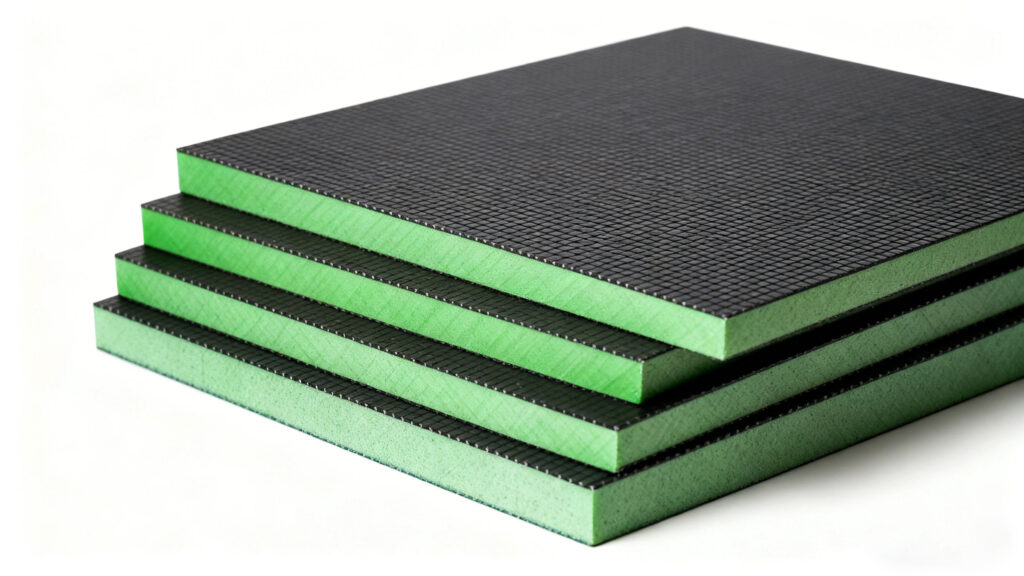
XPS (Extruded Polystyrene): This is the colored foam—often blue, pink, or green. XPS is widely considered the industry go-to for basement walls. Why? It hits the sweet spot with a high R-value (a solid R-5 per inch) and top-tier moisture resistance. Its manufacturing process creates a tight, closed-cell structure that locks out water vapor exceptionally well. According to long-term studies by organizations like the National Research Council Canada, XPS maintains its R-value over time in below-grade applications better than its peers.
Polyiso (Polyisocyanurate): Polyiso is the R-value champion above ground, boasting R-6 or more. But here’s the deal-breaker for basements: its foam core is hygroscopic, meaning it soaks up water like a sponge. When it gets wet, its R-value plummets. Most building professionals advise against using Polyiso on below-grade foundation walls.
XPS foam (R-5 per inch) is the top choice for basements. It resists moisture better than EPS and maintains its R-value, unlike Polyiso, which fails when damp.
Five Key Factors for Choosing the Right Foam Board
Choose basement foam board based on: 1) Moisture resistance, 2) Stable R-value, 3) Strength (15-25 PSI), 4) Long-term durability, and 5) Brand reputation.
- Moisture Resistance: Look for “below-grade” rating.
- Stable R-Value: R-5 that stays R-5 is better than R-6 that fails.
- Compressive Strength: 15-25 PSI handles soil pressure.
- Long-Term Performance: Invest in products proven to last decades.
- Quality Assurance: Buy from reputable brands with clear technical specs.
Wall Problems to Fix Before You Install Any Foam
Before installing insulation, you must fix: active water leaks, efflorescence (white powder), and any existing mold.
Never cover up problems. Foam board manages dampness but is not a fix for leaks.
- Active Leaks: Must be sealed from the outside.
- Efflorescence: Scrape off this chalky residue; it means water is moving through the wall.
- Mold: Clean and kill it completely. Insulation should only go on a clean, dry, and sound surface.
Common Basement Insulation Myths and The Truth
Foam board does not waterproof your basement. It resists vapor, but you still need proper exterior drainage to stop liquid water.
“Foam board is a waterproofing system.”
It’s a vapor barrier. You must address liquid water from the outside first.
“Only R-value matters.”
In basements, moisture resistance is equally critical for longevity.
“All foam is the same.”
The choice between EPS, XPS, and Polyiso dramatically impacts performance and mold risk.
How Much Does It Cost And How Long Does It Take To Import Insulation?
For international orders, budget for a 2-4 week production lead time plus 1-3 weeks shipping. Always get a CIF quote to see the total landed cost (product + shipping + duties).Total Cost: Get a CIF (Cost, Insurance, Freight) quote. This includes the product, shipping, and estimated duties.
Timeline: Plan for 2-4 weeks production plus 1-3 weeks sea freight and customs.
Key Documents: Ensure your supplier provides a Commercial Invoice, Packing List, Bill of Lading, Certificate of Origin, and MSDS.
Your Next Steps for a Successful Basement Project
To start: Assess your basement’s dampness level, Measure your wall square footage, and Gather adhesive, seam tape, and a utility knife.
Assess: Is your basement dry or damp? This decides EPS vs. XPS.
Measure: Calculate total wall area to buy the right amount.
Gather Tools: Get foam board adhesive, specialized foil-faced tape (for seams), and a sharp knife.