Stone finishes promise permanence, but projects succeed on load limits, access routes, geometry, and time on site. Two materials can look similar on a mood board and behave very differently once elevators, substrates, and cure windows enter the picture. This article concentrates on the levers that matter: lighter assemblies that pass structural checks without extra steel, workflows that keep crews installing instead of dry-fitting, and care profiles that hold up under sun, moisture, and cleaning. Expect plain language, practical sequences, and the exact paperwork that turns preference into predictable delivery. The goal is not to crown a universal winner, but to match strengths to constraints so the chosen system performs as specified—on day one and year five.
Flexible Stone vs Natural Stone Weight And Logistics
Weight determines what can be designed, approved, shipped, and installed. Flexible stone veneer typically measures 2.5–4.5 kg/m² (depending on thickness). A 10–12 mm natural-stone panel sits around 25–30 kg/m². On a 100 m² wall that’s roughly 300–450 kg vs 2,500–3,000 kg of dead load. The 2–2.7 ton gap often decides whether slab-edge reinforcement, secondary framing, and extra anchors are required. Staying below these thresholds preserves the original section sizes, simplifies engineering checks, and keeps approvals moving—especially on upper floors and older structures.
Logistics follow the physics. Flexible stone ships flat in wooden boxes. A 20-foot container commonly covers 1,800–2,200 m² (spec- and packing-dependent), whereas crated natural stone of similar face area is typically 400–600 m². On site, wooden boxes move by elevator and through corridors by hand—no crane windows, no forklift lanes, fewer weather delays. Lighter handling also means fewer chips and less staging congestion.
Lower mass broadens substrate options when installed as a tested adhesive assembly with movement-joint detailing: cement board, plaster, concrete, and certain plywood systems become viable without introducing mechanical anchors or subframes. In practice, lightweight sheets are often the difference between a “go” decision and a late redesign.

Faster Installation On Curves And Floors
Rigid stone rewards perfect geometry and patient cutting. Curved walls, columns, and arches usually mean breaking panels into small pieces, repeated dry-fits, and mechanical anchors. Every extra step adds dust, noise, and opportunities for rework. Flexible stone takes a different path. Once the substrate is sound, clean, and within moisture tolerance, sheets are trimmed with a knife and bonded with the specified adhesive. The sheet conforms to the curvature, so the surface reads as one continuous finish instead of a patchwork of segments.
Speed comes from planning the day in zones rather than chasing the wall from end to end. Crews size each zone to the adhesive’s open time and their steady pace, staging cartons and tools within easy reach so every placement goes into a fresh bed. This creates a predictable rhythm: cut, place, roll, move on. With no crane windows to meet and far less wet-saw work, progress depends more on the team’s routine than on site logistics.
Curves and tight returns are handled methodically. Starting from the apex and working outward keeps tension even and maintains grain alignment. Where the radius is very tight, the sheet can be pre-stripped into narrower bands or discreet relief cuts can be introduced on hidden edges; both approaches preserve pattern continuity without slowing the line. Seams are planned into shadow lines or natural breaks, rolled firmly after a short set, and left undisturbed through the initial cure.
Quality controls protect the schedule as much as the finish. A small on-site mock-up locks the seam layout, adhesive notch, and roller pressure before the main run. Quick bond checks at edges confirm adhesion under real site conditions. Movement joints are placed at changes of plane and at designed intervals to absorb thermal movement and prevent telegraphing. Fresh work is shielded from traffic and aggressive cleaning until the cure window passes.
The net effect is a cleaner workflow with fewer bottlenecks. By removing steps that rigid systems require—anchors, heavy cutting, long dry-fits, equipment bookings—crews spend more time installing finish and less time waiting or remaking parts. That is why like-for-like scopes consistently hand over sooner with flexible stone, with less disruption to the surrounding space and a tidier jobsite from start to finish.
Flexible Stone Durability And Compliance vs Natural Stone
“Strong” in cladding isn’t just hardness on day one; it’s how the surface resists sun, water, temperature swings, and cleaning over years. Flexible stone is built as an assembly—primed substrate, adhesive bed, and a reinforced stone surface—so it absorbs small movements without telegraphing cracks. Natural stone relies on mechanical fixing or mortar; it’s rigid and excellent in compression, but more prone to edge chipping and hairline cracking when the substrate moves or when anchors concentrate stress.
Safety and compliance are addressed at the system level. Flexible stone products are available with documented fire classifications.Natural stone is inherently non-combustible, but the overall wall performance still depends on anchors, backer materials, and sealants; those components need their own documentation. In practice, both solutions can meet code—flexible stone simply packages the evidence within a single technical pack that covers bond, weathering, and fire for the intended use.
Exterior use highlights the differences. On façades and near water features, flexible stone’s low water uptake helps prevent staining and bio-growth, and the continuous sheet reduces dirt traps. Natural stone can deliver unmatched depth and grain, but it asks for careful detailing—drainage paths, ventilated cavities where required, corrosion-resistant anchors, and a maintenance schedule that includes inspections and resealing in exposed zones.
Keeping performance consistent comes down to basics: for flexible stone, prepare the substrate, use the specified primer and adhesive, respect open times, and place movement joints at plane changes and long runs. For natural stone, verify anchor layout and tolerance, protect cut edges, control differential movement, and commit to the care plan.
In short, if the priority is a surface that rides out thermal cycles, humidity, and cleaning with minimal intervention, flexible stone offers the more forgiving, low-touch path. If the brief demands the mass and depth of true slab expression and the structure can support it, natural stone still has a clear place—just plan for the upkeep that comes with it.
Cost Comparison and Total Ownership Impact
Unit price is only the first line on a budget. What actually determines value is the full journey from factory to handover and the years that follow: freight and site handling, installation hours, rework and waste, maintenance, and the schedule risk that adds overhead when work slips.
Flexible stone shifts several of those lines at once. Lower mass and compact cartons simplify shipping and building access, so there’s no chasing crane windows or carving forklift lanes through a lobby. On site, an adhesive-bonded workflow replaces anchors and heavy cutting, which shortens setup, reduces dust and noise, and keeps more of each shift focused on coverage rather than coordination. Around curves and returns, the sheet wraps continuously, so there are fewer recuts and fewer chances to chip an edge. After handover, non-porous faces clean with standard methods and typically don’t require periodic resealing, trimming service visits over the life of the space.
A grounded way to compare options is to model the same scope both ways. List the real freight quote, equipment needs, substructure or anchor requirements, crew size and steady output, adhesive or fixing consumption, protection through cure, and the planned cleaning or resealing regime. Projects with high floors, tight corridors, or mixed geometry tend to expose the differences most clearly: fewer equipment bookings, fewer staging moves, and less rework accumulate into earlier turnover and a cleaner site record.
The outcome, in practice: once freight, site handling, added framing on light substrates, extended cutting and dry-fits, and ongoing care are counted, flexible stone often reaches a lower total cost of ownership and an earlier handover—while keeping the stone look the design set out to achieve.
Where Flexible Stone Or Natural Stone Fits Best
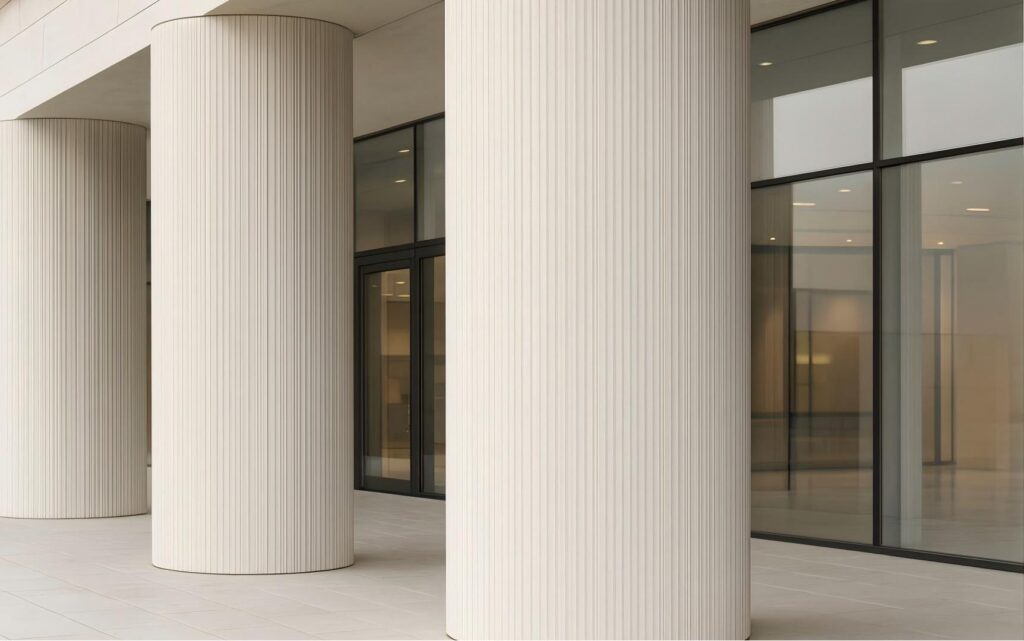
Use the brief to decide, not habit. When structure is tight, access is limited, geometry is curved or irregular, or the program leaves little room for disruption, flexible stone usually delivers the finish with fewer compromises. It goes over prepared substrates (including existing finishes where permitted), wraps columns and arches without breaking the pattern into small segments, and moves through elevators and corridors without heavy equipment. In practice, that combination keeps drawings closer to the original intent and helps approvals, logistics, and installation line up.
Natural stone earns its place where the design calls for true slab presence—deep relief, visible arrises, carved edges, or a monumental feel—and the building can comfortably support the weight and fixing systems. Heritage façades, feature zones at ground level, and spaces where mass is part of the storytelling are typical examples. These applications ask for careful detailing: engineered anchors, drainage and ventilation where required, allowance for differential movement, and a maintenance plan that includes inspections and surface care.
Flexible stone lowers dead load, simplifies access and installs as a continuous skin that follows curves and returns; those traits shorten approvals, cut staging friction and keep crews installing instead of dry-fitting. Performance is documented at the assembly level with method statements and third-party summaries for bond, weathering and fire. Natural stone remains the right call when mass and relief are integral to the concept and the structure comfortably supports anchors, drainage/ventilation where required, and a defined care plan. To close the file with confidence, lock a small on-site mock-up, confirm substrate prep and adhesive/fixing details, file the technical pack with the drawings.With those controls in place, concept, compliance and delivery stay aligned—from specification to handover